• Skip to primary navigation
  • Skip to main content
COPYLAWYER

COPYLAWYER

The Bilingual Company

  • Practice
  • Linguistics
  • Clients
  • Team
  • Contact

Blog

Published // Chapter 11

In this long-form post published on LinkedIn Pulse and titled “Peanuts are for Monkeys: Corporate Recovery Vs. Liquidation“, Achiad Harel of Katzenell Dimant explains how Section 350 of the Companies Law, the Israeli equivalent to Chapter 11, can be used to provide financially distressed companies a runway for corporate turnaround.

I had the pleasure of working with Achiad and providing Editorial Services for this piece.

Achiad Harel is an expert on bankruptcy and restructuring and has developed a unique specialization in corporate recovery with an emphasis on distressed startups and technology companies. Achiad represents clients in all instances of court, arbitration and mediation, and is often appointed liquidator, receiver or special administrator.



Peanutes Published_400

From the post: Peanuts are for Monkeys“:

“When the money runs out, and obligations outweigh assets, most companies, failing to locate an “angel” to save the business, will face liquidation and most likely settle for peanuts with the sale of any IP and activity to the highest bidder.

And when this happens the company in most cases loses its founders – the driving spirit behind the technology, in addition to its going concern value.

But remember: peanuts are for monkeys and this doesn’t have to be the case, as our judicial system offers companies in general, startups included, a better alternative to winding-up, one that protects the company’s personnel and its going concern value while working on a recovery plan.”


Screen Shot 2016-08-07 at 9.37.24 AMLink to the full post.

GO BACK

Commissioned // Cybersecurity

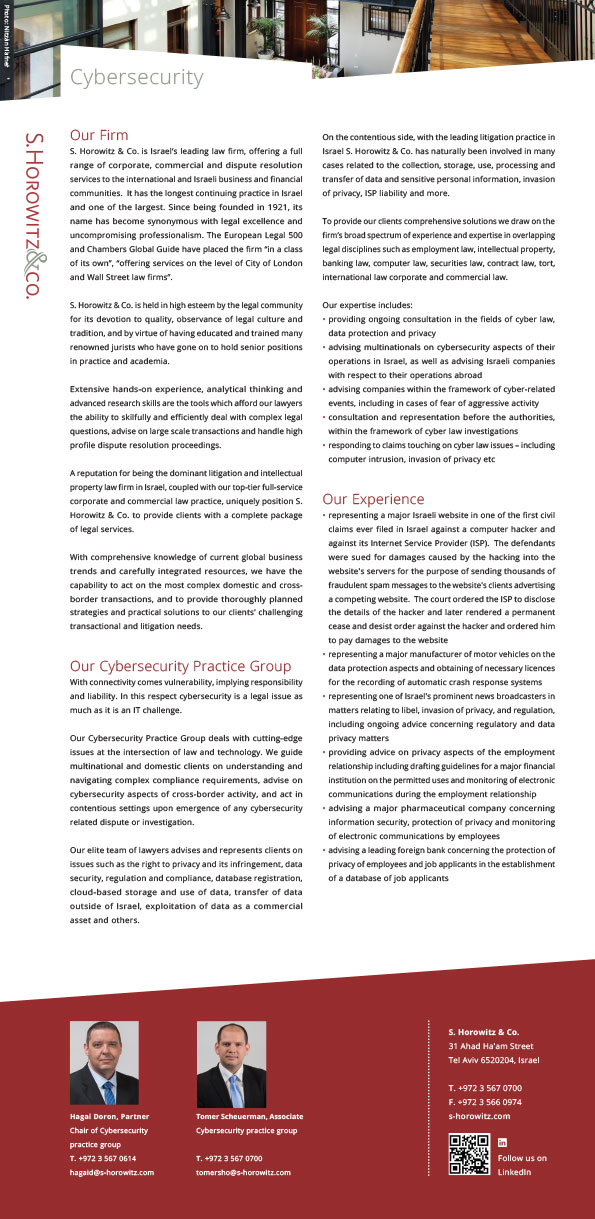
In May 2016, I was commissioned by S. Horowitz & Co. to write bilingual copy for presenting their Cybersecurity practice.

“With connectivity comes vulnerability, implying responsibility and liability. In this respect cybersecurity is a legal issue as much as it is an IT challenge.”

View online version at www.s-horowitz.com


BACK

Published // Repurchase

In this long-form post published on LinkedIn Pulse and titled “A Founder’s Repurchase Dilemma”, Ran Dimant of Katzenell Dimant offers insights to Founders confronted with the unpleasant norm of the Repurchase Agreement.

I had the pleasure of working with Ran and providing Editorial Services for this piece.

Ran Dimant is a Founding Partner of Katzenell Dimant and provides strategic and practical legal advice to public and private companies, equity crowdfunding platforms, startups, founders, investors and various business initiatives.


From the post: “A Founder’s Repurchase Dilemma“:

“While serial entrepreneurs may already be immune, or at the very least indifferent, first-timers often have trouble biting the Repurchase Agreement bullet. How did you feel when your investors told you that reverse-vesting provisions were going to apply to shares that were already yours?

From an emotional aspect, Repurchase Agreements can have a detrimental effect on the founders. “We’ll invest in your company, but you’re going to have to give us your shares and get them back only if you stay the term”.”


Screen Shot 2016-08-07 at 9.38.21 AMLink to the full post.

GO BACK

Published // Reverse IPO

In this long-form post published on LinkedIn Pulse and titled “Advantages of the Reverse IPO”, Ran Dimant of Katzenell Dimant presents two very good reasons for “smaller” companies to consider back door listing: neutralizing risk of failure and circumventing the criteria.

I had the pleasure of working with Ran and providing Editorial Services for this piece.

Ran Dimant is a Founding Partner of Katzenell Dimant and provides strategic and practical legal advice to public and private companies, equity crowdfunding platforms, startups, founders, investors and various business initiatives.


From the post: “Advantages of the Reverse IPO“:

“The phenomena of private companies going public through a process known as Reverse IPO, Reverse Takeover, Reverse Merger or Back Door Listing, is widespread, and on the Tel Aviv Stock Exchange it seems that more companies are opting to purchase existing listed companies rather than going for an initial public offering.

While the reverse IPO may impose the stigma of “not being good enough”, and ultimately being more costly than taking Main Street– there are some very strong arguments in favor of the “back door”, mostly obvious but some only known to  experienced players in this field.”


Screen Shot 2016-08-07 at 9.37.33 AMLink to the full post.

GO BACK

Published // Investment Incentives

In this long-form post published on LinkedIn Pulse and titled “2 Major Benefits for Seed and Pre-seed Investments in Israeli Companies”, Einat Katzenell of Katzenell Dimant explains why Israeli companies qualifying as early stage companies under the amended Angels Law should consider applying for grants under the “early stage companies” Program 8.23 of the OCS.

I had the pleasure of working with Einat and providing Editorial Services for this piece.

Einat Katzenell is the Founding Partner of Katzenell Dimant and provides strategic and practical legal advice to hi-tech, life sciences and biotechnology entrepreneurs, investors, early stage and mature companies, academic institutions and business initiatives.


From the post: “2 Major Benefits for Seed and Pre-seed Investments in Israeli Companies“:

“When presenting your startup to potential investors, there are two advantages available under Israeli law that you might want to emphasize, which could make investing in your startup much more attractive, particularly at the seed and pre-seed stages.

The first advantage is the tax benefits under the “Angels Law”, and the second is the $1:$1 grant under the “early stage companies” OCS program.

The “Angels Law” in its original form failed to achieve its goals, as only a few companies and angel investors capitalized on the benefits offered by the Angels Law. This law was recently amended to extend the applicability of the tax benefits, and as of January 2016 also applies to investments in “early stage” companies. The amended Angels Law also solves issues of uncertainty for the investors in terms of qualifying for the tax benefits that was determined only 3 years after the investment took place.”


Screen Shot 2016-08-07 at 9.38.09 AMLink to the full post.

GO BACK

  • « Go to Previous Page
  • Go to page 1
  • Interim pages omitted …
  • Go to page 6
  • Go to page 7
  • Go to page 8
  • Go to page 9
  • Go to page 10
  • Go to Next Page »

COPYLAWYER

© 2025 The Bilingual Company for Legal Communication Ltd.