• Skip to primary navigation
  • Skip to main content
COPYLAWYER

COPYLAWYER

The Bilingual Company

  • Practice
  • Linguistics
  • Clients
  • Team
  • Contact

published

Published // Crowdfunding 2

In this long-form post published on LinkedIn Pulse and titled “Startups with 1000 Shareholders”, Ran Dimant of Katzenell Dimant discusses legal structural challenges unique to the hot topic of equity crowdfunding.

I had the pleasure of working with Ran and providing Editorial Services for this piece.

Ran Dimant is a Founding Partner of Katzenell Dimant and provides strategic and practical legal advice to public and private companies, equity crowdfunding platforms, startups, founders, investors and various business initiatives.


1000 Shareholders Published_400

מתוך הפוסט: ״חברות הזנק עם 1000 בעלי מניות״:

“גיוס הון באמצעות מימון המונים דורש מבנים משפטיים אשר מסוגלים להתמודד עם פלטפורמה שהיא מעין בורסה אבל היא לא בדיוק בורסה, עם מבנה האחזקות חדש שטרם נוסה, ועם מארג התקשרויות פלטפורמה-חברה וחברה-משקיעים מאתגר בלשון המעטה.

מימון המונים זה שם גדול להרבה דברים. יש מימון המונים לתגמול ומכירה מוקדמת, יש מימון המונים של תרומות ויש מימון המונים לגיוס חוב (הלוואות). כעת אנו מכינים את הקרקע לשלב הבא. זה עולם חדש שנפתח ואנחנו גאים בחלקנו בפיתוח הכלים המשפטיים אשר מאפשרים לזה לקרות.”


Screen Shot 2016-08-07 at 9.37.37 AMקישור לפוסט המלא.

GO BACK

Published // IL companies listed in the US

In this long-form post published on LinkedIn Pulse and titled “IL companies listed in the US may be eligible for exemptions”, Ori Zanco of Katzenell Dimant describes two significant easements for Israeli public companies listed for trade in the United States, which where included in recent amendments to the Israel Securities Regulations.

I had the pleasure of working with Ori and providing Editorial Services for this piece.

Ori Zanco is a Partner at Katzenell Dimant, where he deals with challenging issues of corporate governance and regulatory compliance, securities law and capital markets, ISA and TASE reporting obligations, public equity and debt financing.


From IL companies listed in the US may be eligible for exemptions:

“A couple of weeks ago Prof. Shmuel Hauser spoke at the 2020 Forecast Conference, hosted by TheMarker. If you haven’t read the press I recommend doing so here – the chairman of the Israel Securities Authority shared with the audience of his dream to someday bring an end to the IPO draught, and in doing so listed many steps the capital market regulators are taking in their quest to make the Tel Aviv Stock Exchange more attractive to emerging companies.

While many efforts are aimed at bringing in new companies, the ISA and the TASE are also trying to make life easier for listed companies by removing obstacles and reducing regulation where possible. One such place where regulation has been reduced applies to Israeli companies listed for trade on stock exchanges in the United States.

Recent amendments to the Companies Regulations published in April 2016 set forth that companies listed for trade on NASDAQ, NYSE or AMGX that meet certain criteria can be exempt from the requirement to appoint external directors, as generally required from public Israeli companies.”


Link to the full post.

GO BACK

Published // Chapter 11

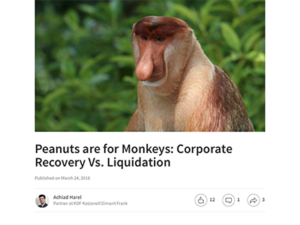
In this long-form post published on LinkedIn Pulse and titled “Peanuts are for Monkeys: Corporate Recovery Vs. Liquidation“, Achiad Harel of Katzenell Dimant explains how Section 350 of the Companies Law, the Israeli equivalent to Chapter 11, can be used to provide financially distressed companies a runway for corporate turnaround.

I had the pleasure of working with Achiad and providing Editorial Services for this piece.

Achiad Harel is an expert on bankruptcy and restructuring and has developed a unique specialization in corporate recovery with an emphasis on distressed startups and technology companies. Achiad represents clients in all instances of court, arbitration and mediation, and is often appointed liquidator, receiver or special administrator.


Peanutes Published_400

From the post: Peanuts are for Monkeys“:

“When the money runs out, and obligations outweigh assets, most companies, failing to locate an “angel” to save the business, will face liquidation and most likely settle for peanuts with the sale of any IP and activity to the highest bidder.

And when this happens the company in most cases loses its founders – the driving spirit behind the technology, in addition to its going concern value.

But remember: peanuts are for monkeys and this doesn’t have to be the case, as our judicial system offers companies in general, startups included, a better alternative to winding-up, one that protects the company’s personnel and its going concern value while working on a recovery plan.”


Screen Shot 2016-08-07 at 9.37.24 AMLink to the full post.

GO BACK

Published // Repurchase

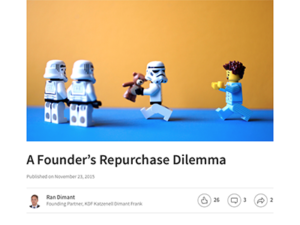
In this long-form post published on LinkedIn Pulse and titled “A Founder’s Repurchase Dilemma”, Ran Dimant of Katzenell Dimant offers insights to Founders confronted with the unpleasant norm of the Repurchase Agreement.

I had the pleasure of working with Ran and providing Editorial Services for this piece.

Ran Dimant is a Founding Partner of Katzenell Dimant and provides strategic and practical legal advice to public and private companies, equity crowdfunding platforms, startups, founders, investors and various business initiatives.


From the post: “A Founder’s Repurchase Dilemma“:

“While serial entrepreneurs may already be immune, or at the very least indifferent, first-timers often have trouble biting the Repurchase Agreement bullet. How did you feel when your investors told you that reverse-vesting provisions were going to apply to shares that were already yours?

From an emotional aspect, Repurchase Agreements can have a detrimental effect on the founders. “We’ll invest in your company, but you’re going to have to give us your shares and get them back only if you stay the term”.”


Screen Shot 2016-08-07 at 9.38.21 AMLink to the full post.

GO BACK

Published // Reverse IPO

In this long-form post published on LinkedIn Pulse and titled “Advantages of the Reverse IPO”, Ran Dimant of Katzenell Dimant presents two very good reasons for “smaller” companies to consider back door listing: neutralizing risk of failure and circumventing the criteria.

I had the pleasure of working with Ran and providing Editorial Services for this piece.

Ran Dimant is a Founding Partner of Katzenell Dimant and provides strategic and practical legal advice to public and private companies, equity crowdfunding platforms, startups, founders, investors and various business initiatives.


From the post: “Advantages of the Reverse IPO“:

“The phenomena of private companies going public through a process known as Reverse IPO, Reverse Takeover, Reverse Merger or Back Door Listing, is widespread, and on the Tel Aviv Stock Exchange it seems that more companies are opting to purchase existing listed companies rather than going for an initial public offering.

While the reverse IPO may impose the stigma of “not being good enough”, and ultimately being more costly than taking Main Street– there are some very strong arguments in favor of the “back door”, mostly obvious but some only known to  experienced players in this field.”


Screen Shot 2016-08-07 at 9.37.33 AMLink to the full post.

GO BACK

  • « Go to Previous Page
  • Go to page 1
  • Go to page 2
  • Go to page 3
  • Go to page 4
  • Go to page 5
  • Go to Next Page »

COPYLAWYER

© 2025 The Bilingual Company for Legal Communication Ltd.