• Skip to primary navigation
  • Skip to main content
COPYLAWYER

COPYLAWYER

The Bilingual Company

  • Practice
  • Linguistics
  • Clients
  • Team
  • Contact

content

Published // Capital Markets

In this long-form post published on LinkedIn Pulse and titled “8 Advantages to Going Public“, Ran Dimant of Katzenell Dimant lists some benefits emerging tech-companies can find in listing their equity on the Tel Aviv Stock Exchange as opposed to VC financing.

I had the pleasure of working with Ran and providing Editorial Services for this piece.

Ran Dimant is a Founding Partner of Katzenell Dimant and provides strategic and practical legal advice to public and private companies, equity crowdfunding platforms, startups, founders, investors and various business initiatives.
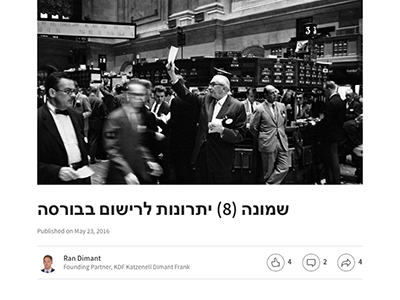

מתוך הפוסט: ״שמונה (8) יתרונות לרישום בבורסה״:

“פעם חברות טכנולוגיה חשבו ששוק ההון גדול עליהם, בסגנון מה יש לסטארט אפ מיוקנעם לחפש ברחוב אחד העם (כיום אחוזת בית). כיום יש כבר יותר מקומץ חברות טק צעירות אשר נסחרות בתל אביב ואנו מקווים שהמגמה תתחזק.

לדעתי, במקרים מסוימים, שוק ההון עשוי להיות עדיף על משקיע פרטי. אמנם חברות ציבוריות נדרשות להוצאות גדולות יותר לעומת חברות פרטיות, וחברה ציבורית גם מחייבת יותר תשומות ניהוליות, אך הניסיון מראה כי לעלות זו נלווים יתרונות רבים, וכמה מהם, בקיצור, להלן.”


Screen Shot 2016-08-07 at 9.37.31 AMקישור לפוסט המלא.

GO BACK

Published // Financing Milestones

In this long-form post published on LinkedIn Pulse and titled “9 Milestone Questions Negotiating Parties Must Ask”, Einat Katzenell of Katzenell Dimant lists some benefits emerging tech-companies can find in listing their equity on the Tel Aviv Stock Exchange as opposed to VC financing.

I had the pleasure of working with Einat and providing Editorial Services for this piece.

Einat Katzenell is the Founding Partner of Katzenell Dimant and provides strategic and practical legal advice to hi-tech, life sciences and biotechnology entrepreneurs, investors, early stage and mature companies, academic institutions and business initiatives.


Milestones Published_400

From the post: “9 Milestone Questions Negotiating Parties Must Ask“:

“Including milestones in commercial agreements enables us to set expectations between the engaging parties and link compensation to achievements.

We advise our clients who are contemplating the use of milestones not to fall for their seemingly straightforward appearance, and to take the time to consider potential issues that may arise down the road.

In general terms, the milestones mechanism defines certain obligations that one party must fulfill in order to trigger the obligations of the other party. Milestones work great when the parties are satisfied with the direction in which the engagement is moving, however they can be a source for bitter squabble and strife if the parties have a falling out – particularly if the milestone terms are not defined clearly.”


Screen Shot 2016-08-07 at 9.38.05 AMLink to the full post.

GO BACK

Published // Tender Offers

In this long-form post published on LinkedIn Pulse and titled “Tender Offers & Control Premiums”, Ran Dimant of Katzenell Dimant discusses the “tender offer” as a takeover bid mechanism, in theory and practice.

I had the pleasure of working with Ran and providing Editorial Services for this piece.

Ran Dimant is a Founding Partner of Katzenell Dimant and provides strategic and practical legal advice to public and private companies, equity crowdfunding platforms, startups, founders, investors and various business initiatives.


Tender Offer Published_400
From Tender Offers & Control Premiums:

“This week saw a public takeover bid for one of the few TASE companies that does not have a controlling shareholder, which happened to involve one of our clients. The takeover bid was carried out through a “tender offer”, the mechanism designed to prevent a situation where control of a public company is acquired without sharing the financial value of control with the other shareholders.

When a takeover is being attempted, the bidding party will generally offer existing shareholders a higher price per share than the going price on the stock exchange, accounting for the financial value that is inherit to control. The “control premium” is the excess price the controlling shareholder is willing to pay for the shares conferring control, reflecting the financial value of the benefits the controlling shareholder expects to gain from controlling the company.”


Screen Shot 2016-08-07 at 9.37.41 AMLink to the full post.

GO BACK

Published // Crowdfunding 2

In this long-form post published on LinkedIn Pulse and titled “Startups with 1000 Shareholders”, Ran Dimant of Katzenell Dimant discusses legal structural challenges unique to the hot topic of equity crowdfunding.

I had the pleasure of working with Ran and providing Editorial Services for this piece.

Ran Dimant is a Founding Partner of Katzenell Dimant and provides strategic and practical legal advice to public and private companies, equity crowdfunding platforms, startups, founders, investors and various business initiatives.


1000 Shareholders Published_400

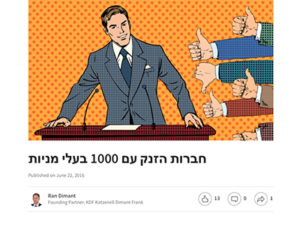
מתוך הפוסט: ״חברות הזנק עם 1000 בעלי מניות״:

“גיוס הון באמצעות מימון המונים דורש מבנים משפטיים אשר מסוגלים להתמודד עם פלטפורמה שהיא מעין בורסה אבל היא לא בדיוק בורסה, עם מבנה האחזקות חדש שטרם נוסה, ועם מארג התקשרויות פלטפורמה-חברה וחברה-משקיעים מאתגר בלשון המעטה.

מימון המונים זה שם גדול להרבה דברים. יש מימון המונים לתגמול ומכירה מוקדמת, יש מימון המונים של תרומות ויש מימון המונים לגיוס חוב (הלוואות). כעת אנו מכינים את הקרקע לשלב הבא. זה עולם חדש שנפתח ואנחנו גאים בחלקנו בפיתוח הכלים המשפטיים אשר מאפשרים לזה לקרות.”


Screen Shot 2016-08-07 at 9.37.37 AMקישור לפוסט המלא.

GO BACK

Published // Chapter 11

In this long-form post published on LinkedIn Pulse and titled “Peanuts are for Monkeys: Corporate Recovery Vs. Liquidation“, Achiad Harel of Katzenell Dimant explains how Section 350 of the Companies Law, the Israeli equivalent to Chapter 11, can be used to provide financially distressed companies a runway for corporate turnaround.

I had the pleasure of working with Achiad and providing Editorial Services for this piece.

Achiad Harel is an expert on bankruptcy and restructuring and has developed a unique specialization in corporate recovery with an emphasis on distressed startups and technology companies. Achiad represents clients in all instances of court, arbitration and mediation, and is often appointed liquidator, receiver or special administrator.


Peanutes Published_400

From the post: Peanuts are for Monkeys“:

“When the money runs out, and obligations outweigh assets, most companies, failing to locate an “angel” to save the business, will face liquidation and most likely settle for peanuts with the sale of any IP and activity to the highest bidder.

And when this happens the company in most cases loses its founders – the driving spirit behind the technology, in addition to its going concern value.

But remember: peanuts are for monkeys and this doesn’t have to be the case, as our judicial system offers companies in general, startups included, a better alternative to winding-up, one that protects the company’s personnel and its going concern value while working on a recovery plan.”


Screen Shot 2016-08-07 at 9.37.24 AMLink to the full post.

GO BACK

  • « Go to Previous Page
  • Go to page 1
  • Go to page 2
  • Go to page 3
  • Go to page 4
  • Go to page 5
  • Go to Next Page »

COPYLAWYER

© 2025 The Bilingual Company for Legal Communication Ltd.