• Skip to primary navigation
  • Skip to main content
COPYLAWYER

COPYLAWYER

The Bilingual Company

  • Practice
  • Linguistics
  • Clients
  • Team
  • Contact

content

Published // Repurchase

In this long-form post published on LinkedIn Pulse and titled “A Founder’s Repurchase Dilemma”, Ran Dimant of Katzenell Dimant offers insights to Founders confronted with the unpleasant norm of the Repurchase Agreement.

I had the pleasure of working with Ran and providing Editorial Services for this piece.

Ran Dimant is a Founding Partner of Katzenell Dimant and provides strategic and practical legal advice to public and private companies, equity crowdfunding platforms, startups, founders, investors and various business initiatives.
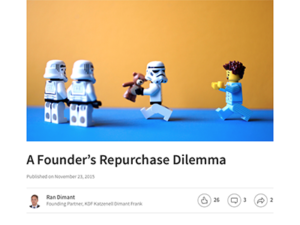

From the post: “A Founder’s Repurchase Dilemma“:

“While serial entrepreneurs may already be immune, or at the very least indifferent, first-timers often have trouble biting the Repurchase Agreement bullet. How did you feel when your investors told you that reverse-vesting provisions were going to apply to shares that were already yours?

From an emotional aspect, Repurchase Agreements can have a detrimental effect on the founders. “We’ll invest in your company, but you’re going to have to give us your shares and get them back only if you stay the term”.”


Screen Shot 2016-08-07 at 9.38.21 AMLink to the full post.

GO BACK

Published // Reverse IPO

In this long-form post published on LinkedIn Pulse and titled “Advantages of the Reverse IPO”, Ran Dimant of Katzenell Dimant presents two very good reasons for “smaller” companies to consider back door listing: neutralizing risk of failure and circumventing the criteria.

I had the pleasure of working with Ran and providing Editorial Services for this piece.

Ran Dimant is a Founding Partner of Katzenell Dimant and provides strategic and practical legal advice to public and private companies, equity crowdfunding platforms, startups, founders, investors and various business initiatives.


From the post: “Advantages of the Reverse IPO“:

“The phenomena of private companies going public through a process known as Reverse IPO, Reverse Takeover, Reverse Merger or Back Door Listing, is widespread, and on the Tel Aviv Stock Exchange it seems that more companies are opting to purchase existing listed companies rather than going for an initial public offering.

While the reverse IPO may impose the stigma of “not being good enough”, and ultimately being more costly than taking Main Street– there are some very strong arguments in favor of the “back door”, mostly obvious but some only known to  experienced players in this field.”


Screen Shot 2016-08-07 at 9.37.33 AMLink to the full post.

GO BACK

Published // Investment Incentives

In this long-form post published on LinkedIn Pulse and titled “2 Major Benefits for Seed and Pre-seed Investments in Israeli Companies”, Einat Katzenell of Katzenell Dimant explains why Israeli companies qualifying as early stage companies under the amended Angels Law should consider applying for grants under the “early stage companies” Program 8.23 of the OCS.

I had the pleasure of working with Einat and providing Editorial Services for this piece.

Einat Katzenell is the Founding Partner of Katzenell Dimant and provides strategic and practical legal advice to hi-tech, life sciences and biotechnology entrepreneurs, investors, early stage and mature companies, academic institutions and business initiatives.


From the post: “2 Major Benefits for Seed and Pre-seed Investments in Israeli Companies“:

“When presenting your startup to potential investors, there are two advantages available under Israeli law that you might want to emphasize, which could make investing in your startup much more attractive, particularly at the seed and pre-seed stages.

The first advantage is the tax benefits under the “Angels Law”, and the second is the $1:$1 grant under the “early stage companies” OCS program.

The “Angels Law” in its original form failed to achieve its goals, as only a few companies and angel investors capitalized on the benefits offered by the Angels Law. This law was recently amended to extend the applicability of the tax benefits, and as of January 2016 also applies to investments in “early stage” companies. The amended Angels Law also solves issues of uncertainty for the investors in terms of qualifying for the tax benefits that was determined only 3 years after the investment took place.”


Screen Shot 2016-08-07 at 9.38.09 AMLink to the full post.

GO BACK

Published // Brainnovations 2

In this update published on LinkedIn Pulse and titled “Brainnovations 2nd Cycle is Accepting Applications”, Einat Katzenell of Katzenell Dimant encourages braintech entrepreneurs to submit applications to participate in Brainnovations – IBT’s launchpad program supporting early stage startups.

I had the pleasure of working with Einat and providing Editorial Services for this piece.

Einat Katzenell is the Founding Partner of Katzenell Dimant and provides strategic and practical legal advice to hi-tech, life sciences and biotechnology entrepreneurs, investors, early stage and mature companies, academic institutions and business initiatives.


From the update: “Brainnovations 2nd Cycle is Accepting Applications“:

“As you may know our firm has been a strategic partner of Israel Brain Technologies (IBT) since its inception back in 2011, and we are proud of our ongoing contribution to IBT’s monumental effort to promote advances in neurotechnology.

This month will see the culmination of IBT’s activities, as Brainnovations – IBT’s launchpad program, enters its final phase and the talented participants prepare for presenting their accomplishments before angels, VC’s, life science multinationals, incubators and other investors at the upcoming demo day.”


Screen Shot 2016-08-07 at 9.38.29 AMLink to the full update.

GO BACK

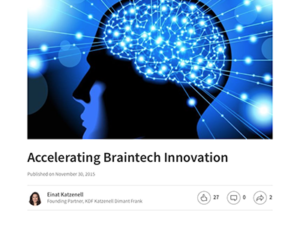
Published // Brainnovations

In this long-form post published on LinkedIn Pulse and titled “Accelerating Braintech Innovation”, Einat Katzenell of Katzenell Dimant shares insights from her work with Israel Brain Technologies and its launchpad program – Brainnovations, and explains why braintech doesn’t fit the common rubric.

I had the pleasure of working with Einat and providing Editorial Services for this piece.

Einat Katzenell is the Founding Partner of Katzenell Dimant and provides strategic and practical legal advice to hi-tech, life sciences and biotechnology entrepreneurs, investors, early stage and mature companies, academic institutions and business initiatives.


From the post: “Accelerating Braintech Innovation“:

“While other areas of high technology categorically take a B2B or B2C approach to marketing, Braintech doesn’t quite fit the common rubric. Consider the identity of your customers (the who) and the means by which they’re going to pay for your product (the how) – it’s plain to see that neurotechnology is in a class of its own.

Resolving the who and how issues at the very early stages of development is critical, because even though achieving scientific validation is fantastic – proving something works doesn’t in and of itself mean that it can be commercialized.

Imaging, cranial stimulation, implant technologies, cranial surface measurements, cell therapy and brain chemistry pharmaceuticals are some of the current technologies available on the market, and for the most part are used in medical institutions, specialized clinics, universities and research centers, and ultimately paid for by the insurance companies.”


Screen Shot 2016-08-07 at 9.38.25 AMLink to the full post.

GO BACK

  • « Go to Previous Page
  • Go to page 1
  • Go to page 2
  • Go to page 3
  • Go to page 4
  • Go to page 5
  • Go to Next Page »

COPYLAWYER

© 2025 The Bilingual Company for Legal Communication Ltd.